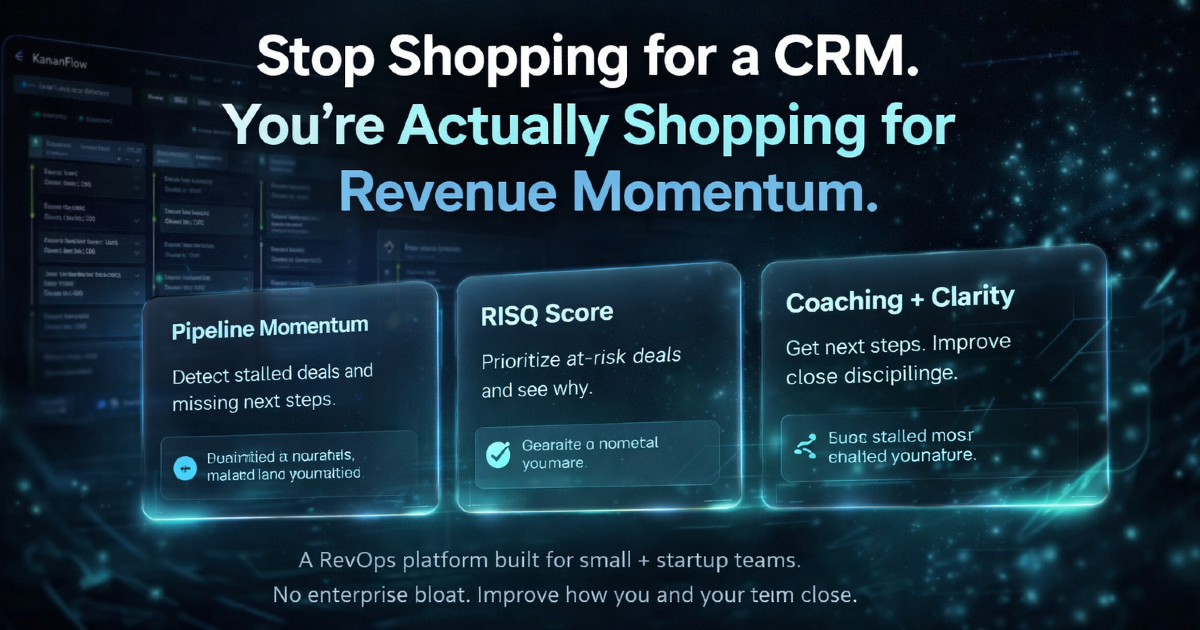
Stop Shopping for a CRM. You’re Actually Shopping for Revenue Momentum.
Most SMB owners and startup founders don’t fail because they lack leads.
They fail because deals stall quietly:
- “We’ll follow up next week.”
- “They went dark.”
- “We’re waiting on legal.”
- “It’s in the pipeline.”
And then the month ends.
If you’re looking for a CRM right now, you’re probably feeling one (or all) of these:
- Your pipeline looks busy, but revenue still feels unpredictable
- Your team is “working hard,” but you can’t tell what’s actually moving
- Your CRM is either too light to be useful or so bloated it becomes a job
- You’re paying for features you don’t use, plus extra seats, plus add-ons, plus “one more tool”
A CRM can store information.
But it can’t fix the real problem:
You don’t need more tracking. You need better execution.
That’s what StageFlow was built for.
What most CRMs get wrong (especially for small teams)
CRMs were designed to do two things well:
- Record details about contacts and deals
- Produce reports about what happened (or what might happen)
But here’s what founders and small teams actually need:
- A system that tells the truth about risk
- A workflow that forces clarity
- A cadence that creates momentum
- A tool that makes people better at closing
Most CRM platforms weren’t built for that.
They were built to be configured by admins, managed by ops teams, and customized endlessly. That’s not your reality.
Your reality: a team wearing five hats, moving fast, with zero patience for bloat.
StageFlow was built by small business owners for small business owners and startup teams who need a clear, calm system that drives revenue forward.
StageFlow is not “a better CRM.”
StageFlow is a Revenue Execution System.
It’s designed around a simple, high-stakes truth:
Revenue isn’t lost because you didn’t log enough data.
It’s lost because time passed without meaningful progress.
StageFlow exists to prevent that.
It does it in three ways:
1) Clarity: You always know what matters next
StageFlow is built so that you can open it and immediately see:
- What’s closest to closing
- What’s at risk
- What needs a next step
- Who’s stuck
- What should happen today
Not 47 dashboards. Not a pile of activity logs.
Just the handful of moves that actually create revenue.
2) Momentum: It prevents deals from dying quietly
Most teams don’t lose deals in dramatic fashion.
They lose them by forgetting, delaying, and letting uncertainty sit too long.
StageFlow is built to surface:
- stalled opportunities
- missing next steps
- “hope-based” pipeline items
- deals that look alive but are actually decaying
Momentum isn’t motivation. It’s structure.
StageFlow gives you structure.
3) Improvement: It makes your team better by using it
This is the part most people don’t expect.
Traditional CRMs are passive. They don’t improve capability.
They just store inputs.
StageFlow is designed to build stronger close habits over time:
- clearer next steps
- cleaner stage discipline
- consistent follow-up
- better deal hygiene
- better handoffs
That’s how a tool increases win-rate without needing “more effort.”
The real differentiator: RISQ Score (Revenue Risk Score)
A pipeline can look full and still be fragile.
StageFlow makes that fragility visible.
RISQ Score is StageFlow’s revenue risk scoring system (not a trademark).
It is designed to answer one question with brutal clarity:
Where is revenue at risk right now — and why?
RISQ Score is built around the reality of small teams:
- Time passing without progress increases risk
- Meaningful progress reduces risk
- Noise activity doesn’t count
- Risk is ranked so you know what matters first
This matters because most founders are making decisions with incomplete signals.
RISQ Score gives you a single anchor metric that:
- exposes deal decay early
- forces prioritization
- drives coaching conversations
- creates accountability without micromanagement
And because it’s tied to deal behavior, it’s not just a number.
It’s a coaching system.
Why StageFlow reduces churn and increases LTV (and CRMs don’t)
Churn rarely starts at renewal.
It starts during the first sales process:
- unclear expectations
- weak handoffs
- overpromising
- inconsistent follow-up
- misalignment on success outcomes
A “CRM sale” can close fast and still create a short-lived customer.
StageFlow is built for partnership-style selling—the kind that produces:
- better-fit customers
- better onboarding handoffs
- better expectation setting
- better retention conversations
When your pipeline system reinforces clarity and discipline during the sale, it improves downstream outcomes:
Better sales process → better customers → lower churn → higher LTV.
That’s not theory. That’s operational reality.
Built for teams 1–50 (because that’s where the bloat hurts most)
StageFlow is for:
- SMB owners who need predictable revenue but don’t want enterprise admin work
- Startup founders who need a serious pipeline system without paying for a platform built for Fortune 500
- Small revenue teams who need coaching and accountability without a heavy CRM
If you’re in the “1–50” range, enterprise platforms punish you:
- setup complexity
- seat creep
- add-on pricing
- feature overload
- slow adoption
- “CRM becomes the job”
StageFlow cuts through that.
It’s intentionally minimal in the places that don’t matter—and deeply engineered in the places that do:
- execution
- momentum
- coaching
- pipeline truth
“So… is StageFlow a CRM replacement?”
Yes. But that’s not the point.
StageFlow replaces the traditional CRM model of:
- store information
- log activity
- generate reports
With a system that:
- drives daily focus
- exposes risk early
- reinforces best practices
- improves close habits automatically
In other words:
A CRM tracks sales. StageFlow improves sales.
What you’ll notice in the first week
Founders and operators usually report the same changes quickly:
- Less anxiety
- Because you’re no longer guessing what matters.
- Fewer dropped balls
- Because stalled deals and missing next steps don’t hide.
- Sharper execution
- Because the system nudges better habits—without extra meetings.
- A pipeline that tells the truth
- Because risk is ranked and visible.
That’s what “better software” should feel like:
calm, clear, and corrective.
If you’re evaluating CRMs right now, here’s the real question
Don’t ask:
- “Which CRM has the most features?”
- “Which CRM integrates with everything?”
- “Which CRM is cheapest?”
Ask this:
Which system will make my team better at closing… without adding admin work?
If the answer is “none,” that’s why StageFlow exists.
Try StageFlow free
If you want a pipeline system that:
- creates clarity
- builds momentum
- improves close discipline
- and strengthens partnership-style selling
Create your free account and set it up in minutes:
https://stageflow.startupstage.com
No credit card. No onboarding calls.
Just a clean revenue system built for small teams that need results.
Create your free account now at https://stageflow.startupstage.com
Keep 100% of your company.
StartupStage gives founders a coordinated expert team — CMO, CTO, CFO and legal — for $297/month with zero equity.
See how the anti-accelerator works