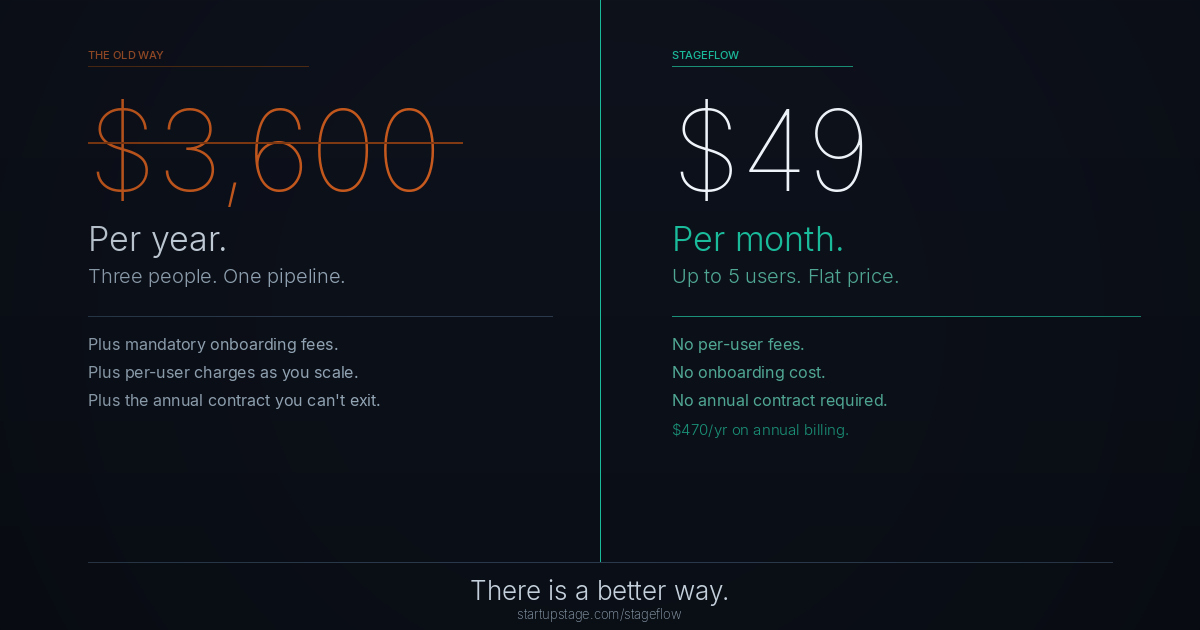
StageFlow is a HubSpot alternative built for founders and small sales teams of 1–50 people. Where HubSpot charges $3,600 or more per year for a three-person team on Sales Hub Professional, StageFlow's Startup plan starts at $49 per month for up to 5 users with no per-user fees and no mandatory onboarding cost. StageFlow includes Plan My Day (an AI-generated daily action plan ranked by revenue impact), a real-time RISQ Score that computes pipeline risk automatically, and a Run-Rate HUD that keeps MTD, QTD, and YTD pacing always visible — features HubSpot does not offer natively at any price tier. Teams can migrate from HubSpot in under an hour using StageFlow's CSV import wizard, which auto-detects HubSpot export files and maps fields automatically.
That is the moment Jeremy Holland built StageFlow to prevent.
HubSpot is not a bad product. For a 200-person company with a dedicated RevOps team, a marketing department, and someone whose entire job is maintaining the CRM, it is genuinely powerful. But for a founder running a three-person sales team? You are paying enterprise prices to operate a system that was designed for a business ten times your size.
This article breaks down exactly why thousands of founders and small sales teams are leaving HubSpot, what they are switching to, and whether StageFlow is the right fit for your business.
The Real Cost of HubSpot for Small Teams
HubSpot's free tier gets a lot of attention. It is where most small businesses start. But the free plan is deliberately limited, and the gap between free and functional is steeper than it appears.
Once you need automation, custom reports, or more than two pipelines, you are looking at the Professional tier. That starts at $90 per user per month for the Sales Hub alone. Add a second user, tack on the mandatory onboarding fee (ranging from $1,500 to $3,000 for Professional), and you are spending well over $5,000 in year one before you have sent a single email sequence.
HubSpot's pricing is also structured around contacts, not just users. As your prospect list grows, so does your bill. Independent reviews of HubSpot pricing consistently find that the realistic annual cost for a small team with basic automation needs runs between $6,000 and $15,000 per year, depending on contact volume and the hubs you actually use.
The result is a familiar trap: you are paying for a platform built for scale you do not yet have, while the features you actually need are locked behind the next tier up.
What HubSpot Was Built For (And Why That Matters)
HubSpot's architecture reflects its history. It was built around inbound marketing first, with CRM functionality added over time to support larger go-to-market teams. The platform is genuinely excellent at connecting marketing automation, content management, customer service ticketing, and sales pipelines into a single ecosystem.
That is exactly the problem for a founder with a team of three to ten people.
You do not need a content management system. You do not need a customer service ticketing hub. You do not need a multi-hub orchestration layer. You need to know which deals are slipping, what you should be working on today, and whether you are on track to hit your number this month.
HubSpot was not designed to answer those three questions clearly and fast. It was designed to manage an entire revenue organization across multiple departments. For small teams, that depth creates friction, not speed.
How StageFlow Is Different
StageFlow was built from the ground up for founders and sales teams of one to fifty people. Not a simplified version of an enterprise platform. Not a stripped-down feature set. A system designed from the first line of code around the question: what does a founder actually need to run revenue without running reports?
Here is what that looks like in practice.
Plan My Day
Every morning, StageFlow's AI generates a structured daily plan based on your live pipeline data. It does not just list tasks. It prioritizes actions by run-rate status, surfaces deals that need attention, and tells you exactly where to spend your time.
Traditional CRMs, including HubSpot, show you data. Plan My Day translates data into decisions. You open StageFlow in the morning and your day is already organized.
RISQ Score
StageFlow's RISQ scoring engine runs continuously in the background, computing a quantified risk score for your pipeline using weighted drivers like deal age, stage velocity, and activity gaps. You can see exactly which deals are at risk and why, without relying on gut feel or manual health fields.
HubSpot's pipeline health features rely on activity counts and manual status fields. RISQ is computed automatically and updates in real time as deals move through your pipeline.
Run-Rate HUD
The run-rate HUD shows your MTD, QTD, and YTD pacing directly in the dashboard, so you know at a glance whether you are ahead, on pace, or behind without building a custom report or exporting data to a spreadsheet.
Flat Pricing at $49 Per Month
StageFlow starts at $49 per month for up to five users. Not per user. Not per contact tier. One flat price that does not change as your team grows from one rep to ten.
For a three-person team, you are looking at $470 per year on annual billing instead of $3,600 or more. That is the difference between a tool that serves your business and a bill that taxes it.
Direct Comparison: StageFlow vs HubSpot
What You NeedHubSpotStageFlowDaily AI-generated action planNot availablePlan My Day, built inQuantified pipeline risk scoringManual health fieldsRISQ score with computed driversLive pacing against monthly / quarterly targetsCustom reports requiredRun-rate HUD, always visiblePricing for a team of 3$3,600+ per year$470 per year on annual billingPer-user pricingYesNoOffline capability with sync statusLimitedOffline queue with sync indicatorMigrate from HubSpot with auto-mappingN/AAuto-detects HubSpot CSV and maps fieldsTime to first dealHours to daysMinutes
Who Should Stay on HubSpot
StageFlow is not the right choice for everyone. HubSpot makes sense if:
- You have a marketing team that needs advanced automation and campaign management
- Your CRM is deeply integrated with a content strategy and you need a CMS
- You have dedicated RevOps staff to manage the platform
- Your team is larger than 50 people and needs enterprise-grade customization
If any of those describe you, HubSpot's depth is worth the cost.
But if you are a founder, a sales lead, or a small team that needs to close deals without operating a CRM full time, the math does not work in HubSpot's favor.
Moving from HubSpot to StageFlow
One of the most common objections to switching CRMs is migration pain. StageFlow eliminates it.
The CSV import wizard auto-detects HubSpot export files, maps your fields automatically, suggests stage alignments, and runs a dry-run preview before anything is committed to your live pipeline. You can see exactly what will import, catch errors before they happen, and download a CSV of any failed rows to fix and re-import.
Most teams are fully migrated in under an hour.
Frequently Asked Questions
Is StageFlow a good replacement for HubSpot for a small business? StageFlow is purpose-built for small sales teams of one to fifty people. It replaces the core CRM and pipeline functions of HubSpot's Sales Hub with AI-native features designed for founders, at a fraction of the cost. If you primarily use HubSpot for pipeline management and deal tracking, StageFlow covers that ground more efficiently and affordably.
How much does StageFlow cost compared to HubSpot? StageFlow starts at $49 per month for up to five users, with no per-user fees and no contact-tier pricing. HubSpot's Sales Hub Professional starts at $90 per user per month, plus mandatory onboarding fees. For a three-person team, StageFlow costs $470 per year on annual billing versus $3,600 or more annually on HubSpot.
Can I import my HubSpot data into StageFlow? Yes. StageFlow's CSV import wizard auto-detects HubSpot export files, maps your fields automatically, and previews the import before it goes live. Most teams complete the migration in under an hour.
Does StageFlow have AI features like HubSpot Breeze? StageFlow's AI is focused specifically on revenue execution: generating daily action plans from your pipeline, scoring deal risk with the RISQ engine, and keeping your run-rate pacing visible at all times. It uses multiple AI providers and is designed for founders who want decisions, not dashboards.
What is the biggest difference between HubSpot and StageFlow? HubSpot is an all-in-one marketing and sales platform designed for growing organizations with multiple departments. StageFlow is a revenue execution workspace designed specifically for founders and small sales teams. HubSpot asks you to adapt to its structure. StageFlow is structured around how a small sales team actually works.
If you are paying HubSpot prices for a three-person team, it is worth taking 10 minutes to see what StageFlow does differently.
Try StageFlow free at startupstage.com/stageflow
Keep 100% of your company.
StartupStage gives founders a coordinated expert team — CMO, CTO, CFO and legal — for $297/month with zero equity.
See how the anti-accelerator works