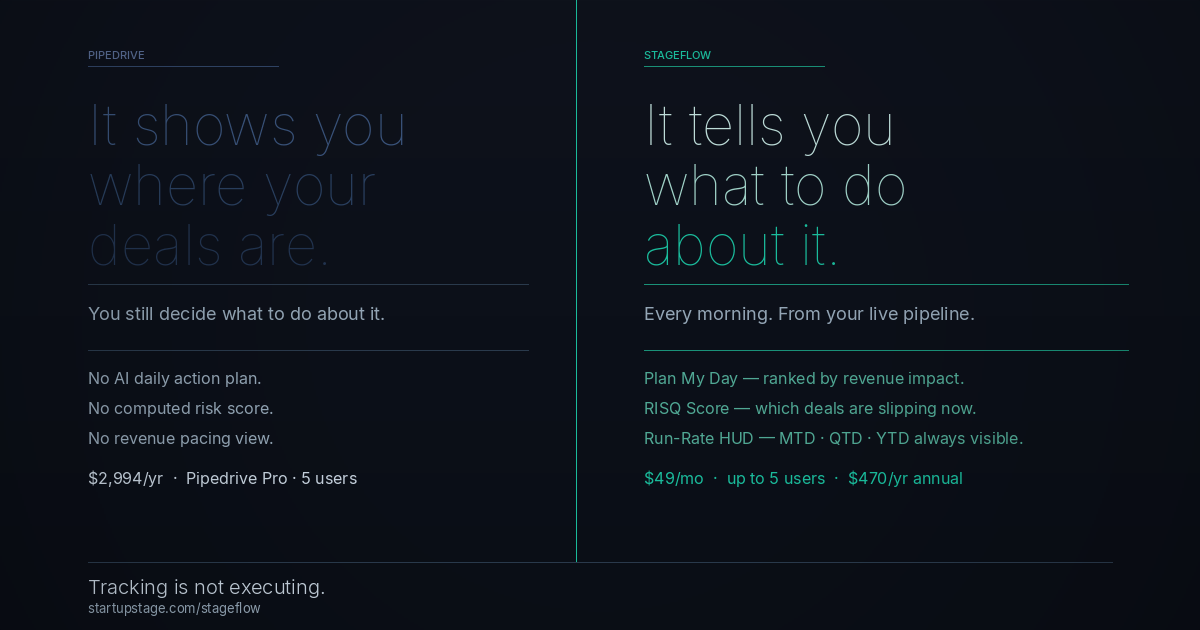
StageFlow is a Pipedrive alternative for founders who need more than pipeline tracking. Pipedrive is a visual deal-tracking tool that shows where deals are in a pipeline; but it does not generate a daily action plan, does not compute deal risk automatically, and does not show revenue pacing against monthly or quarterly targets. StageFlow adds these execution layers on top of a full pipeline: Plan My Day ranks daily actions by revenue impact using live pipeline data; RISQ Score computes a real-time risk rating for each deal using weighted drivers like stage velocity and activity gaps; and the Run-Rate HUD keeps MTD, QTD, and YTD pacing always visible. Pipedrive's Advanced plan costs approximately $2,994 per year for five users. StageFlow's Startup plan starts at $49 per month for up to five users ($470/yr on annual billing) with no per-user fees. The core distinction: Pipedrive tracks pipeline position. StageFlow drives revenue execution.
Pipedrive was founded in 2011 as a reaction to Salesforce.
The founders had a simple thesis: CRM software was built for enterprise, not for sales teams that actually needed to sell. The result was a clean, visual pipeline tool that made deal tracking fast and intuitive. For a decade, it was one of the best answers to the question: what does a small sales team actually need?
The problem is that the question has changed.
Running revenue in 2025 is not just about knowing where deals are. It is about knowing which ones are at risk before they go cold, knowing what to work on this morning rather than wading through a list of overdue tasks, and knowing whether you are on track to hit your number without building a custom report. These are execution questions, not pipeline questions, and they require a fundamentally different kind of tool.
Pipedrive is still a good pipeline tracker. But a pipeline tracker is no longer enough.
What Pipedrive Does Well
It is worth being direct about what Pipedrive gets right, because the comparison matters.
Pipedrive's visual pipeline is clean and genuinely fast to use. The drag-and-drop kanban board is well-considered. The interface for adding deals and moving them through stages is as friction-free as any CRM on the market. For a sales team that primarily needs to track deal progress and log activity, Pipedrive delivers that without much training or setup.
Pipedrive also has solid activity-based selling prompts, a reasonable mobile app, and integration with common tools through its marketplace.
Where Pipedrive Falls Short for Revenue-Focused Founders
The gap between what Pipedrive offers and what a founder actually needs has been widening.
No structured daily planning. Pipedrive shows you your pipeline. It does not tell you what to do with it today. You can see overdue activities and set reminders, but there is no mechanism that synthesizes your pipeline state, your pacing against targets, and your at-risk deals into a ranked action plan for the day. That synthesis is the work most founders do manually every morning, usually in a notebook or a spreadsheet.
Manual risk assessment. Pipedrive has activity-based warnings that flag deals without recent interaction, but there is no computed risk score. If you want to know which deals are most at risk right now, you are reading through your pipeline and making that judgment yourself. For a small team with 30 active deals, that takes time you do not have.
Per-user pricing that adds up. Pipedrive starts at 14 euros per user per month (Essential tier), rising to 34 euros per user (Advanced) for email automation and pipeline stage logic. For a team of five on the Advanced plan, you are spending over $2,000 per year. The pricing model does not change as you add people.
AI features are limited and shallow. Pipedrive's AI capabilities have been criticized as one of its primary weaknesses relative to newer entrants. Activity suggestions and basic automations exist, but there is no AI-generated daily plan and no real-time risk intelligence engine.
Reporting requires effort. Getting a clear view of your monthly pacing or quarterly forecast in Pipedrive requires building and maintaining reports. That is not difficult, but it is ongoing work that does not generate revenue.
What a Revenue Execution Workspace Does Differently
StageFlow was designed around a different starting point. The question was not "how do we track pipeline?" It was: "what does a founder need to actually run revenue every day?"
The answer is three things: a plan, a risk view, and a pacing check. StageFlow delivers all three from a single dashboard without any manual setup or report building.
Plan My Day
When you click Plan My Day, StageFlow's AI analyzes your live pipeline and generates a structured, prioritized daily action plan. It does not show you a generic list of follow-ups. It looks at your run-rate pacing, identifies at-risk deals, surfaces deals that are overdue for movement, and produces a ranked action list organized by what matters most today.
This is the first thing that separates StageFlow from Pipedrive. Pipedrive shows you data. StageFlow turns data into a decision.
RISQ Score
StageFlow's RISQ engine computes a real-time risk score for your pipeline using weighted drivers: deal age, stage velocity, activity patterns, and close date proximity. The Pipeline Health panel shows your score and the specific drivers pulling it up or down.
You can see, at any moment, whether your pipeline is healthy or deteriorating, and you can see exactly why. That is a different capability from Pipedrive's activity flags, which tell you a deal has gone quiet but do not quantify the total risk to your forecast.
Run-Rate HUD
Your MTD, QTD, and YTD pacing is permanently visible in the StageFlow dashboard. There is no report to build or refresh. You always know whether you are ahead or behind your number. For a founder who makes decisions daily based on revenue pacing, this changes how you operate.
Flat Pricing for the Whole Team
StageFlow starts at $49 per month for up to five users. Not per user. Not per tier of features. One price that does not change as your team grows.
A five-person team on Pipedrive Advanced pays over $2,000 per year. The same team on StageFlow pays $470 on annual billing. The savings compound as your team grows.
Direct Comparison: StageFlow vs Pipedrive
What You NeedPipedriveStageFlowAI daily action planningNot availablePlan My Day, built inQuantified real-time risk scoringActivity flags onlyRISQ score with computed driversLive MTD/QTD/YTD pacingCustom reports requiredRun-rate HUD, always visiblePricing for a team of 5$2,000+ per year (Advanced)$470 per year on annual billingPer-user pricingYesNoIndustry pipeline templates with migrationNot availableBuilt inOffline queue with sync statusLimitedFull offline queue with indicatorMigrate from PipedriveN/AAuto-detects Pipedrive CSV export
The Real Difference: Tracking vs Executing
This is the core distinction between Pipedrive and StageFlow, and it is worth stating plainly.
Pipedrive is a pipeline tracker. It is very good at showing you where your deals are. You still have to decide what to do about them.
StageFlow is a revenue execution workspace. It tells you where your deals are, which ones are at risk, and what to do today. The gap between those two things is the time you spend every morning translating pipeline data into a plan, and every week building reports to understand your forecast.
For a founder whose time is the most valuable resource in the business, that gap is significant.
Who Should Stay on Pipedrive
Pipedrive remains a solid choice if:
- Your team's primary need is a clean visual pipeline with minimal overhead
- You are early-stage and do not yet need run-rate pacing or risk scoring
- You have a salesperson managing the CRM who prefers Pipedrive's activity-based workflow
If you are past the stage of just needing to track deals, and you need your CRM to actively help you run revenue, the comparison shifts.
Moving from Pipedrive to StageFlow
StageFlow's CSV import wizard includes a built-in schema for Pipedrive export files. It auto-detects the source, maps fields and stages automatically, runs a preview before any data is committed, and downloads a report of any rows that need attention. Most teams migrate in under an hour.
Frequently Asked Questions
Is StageFlow a good alternative to Pipedrive for a small sales team? StageFlow is purpose-built for founders and sales teams of one to fifty people. It covers Pipedrive's core pipeline tracking functions and adds AI-generated daily planning, real-time risk scoring, and live revenue pacing, at a lower total cost. For teams that have outgrown a basic pipeline view, StageFlow is the natural next step.
How does StageFlow pricing compare to Pipedrive? StageFlow starts at $49 per month for up to five users, with no per-user fees. Pipedrive's Essential plan starts at 14 euros per user per month, with meaningful automation on the Advanced plan at 34 euros per user. For a team of five, StageFlow costs $470 per year on annual billing versus $2,000+ on Pipedrive Advanced.
Does StageFlow have AI features that Pipedrive lacks? Yes. StageFlow includes Plan My Day, which generates a structured daily action plan from your live pipeline, and the RISQ engine, which computes a real-time risk score for your pipeline with explicit drivers. Pipedrive has limited AI capability focused primarily on activity suggestions.
Can I import my Pipedrive data into StageFlow? Yes. StageFlow's CSV import wizard auto-detects Pipedrive export files, maps your fields and stages automatically, and previews the import before it goes live. Most teams complete migration in under an hour.
What does revenue execution mean versus pipeline tracking? Pipeline tracking shows you where your deals are. Revenue execution combines that view with daily action planning (what to do today), risk scoring (which deals are slipping), and pacing visibility (are you on track for your number). StageFlow is designed for revenue execution. Most traditional CRMs, including Pipedrive, are designed for pipeline tracking.
Is StageFlow good for a solo founder? Yes. StageFlow's flat pricing starts at $49 per month for up to five users, and Plan My Day is specifically useful for a solo founder who needs to prioritize their time without spending 30 minutes planning their day manually.
You built your business to close deals, not to manage software.
See what running revenue looks like with StageFlow at startupstage.com/stageflow
Keep 100% of your company.
StartupStage gives founders a coordinated expert team — CMO, CTO, CFO and legal — for $297/month with zero equity.
See how the anti-accelerator works